ARC West’s funding ended on 31 March 2026. This site is an archive and is no longer updated.
How do public health practitioners use parental guidance for talking to children about weight?
3 March 2026
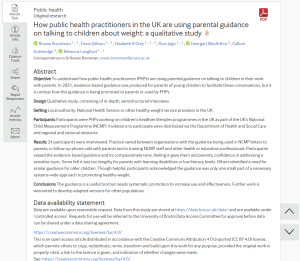
How public health practitioners are using parental guidance to talk to children is explored in a new qualitative study published in BMJ Open.
Evidence-based guidance was developed in 2021 to support parents in navigating sensitive conversations about weight with young children. This new research sought to understand how this guidance is being integrated into practice by those working in the National Child Measurement Programme (NCMP) and other healthy weight services across the UK.
The study involved in-depth interviews with 24 practitioners from local authorities, the NHS and community interest companies. Several themes emerged:
- Integration into routine services: Practitioners reported using the guidance in several practical ways. Most notably they included links or snippets in NCMP feedback letters sent to parents, used it as a talking point during follow-up phone calls and as a training tool for staff
- Confidence and tone: Participants valued the guidance for its “compassionate and non-stigmatising” tone. Many practitioners felt that having a structured, evidence-based resource gave them greater confidence when addressing what is often perceived as a “taboo” or difficult subject
- Barriers to use: While the content was praised, some practitioners noted that the length of the guidance could be a barrier for parents with lower literacy levels or learning disabilities. They also noted a demand for similar resources tailored for older children and adolescents
- The “bigger picture”: While the guidance was seen as a useful tool, practitioners emphasised that it is only one small component of the “systems-wide approach” required to effectively promote healthy weight and address the complexities of childhood obesity
The research highlights that while the guidance is a welcome addition to the public health toolkit, its impact is limited by a lack of systematic, national-level promotion.
Rowan Brockman, lead author of the study, noted:
“Our findings suggest that practitioners find the guidance helpful for framing conversations with parents in a supportive and empowering way. However, to maximise its reach, there is a need for more formal integration into local and national public health strategies.”
Recommendations for public health practitioners
Based on the study, public health teams may wish to consider:
- Refining communication: Ensuring that links to the guidance are prominent in NCMP communications
- Professional development: Using the guidance as a framework for training staff on how to conduct sensitive, weight-related conversations
- Local adaptation: Considering how the core messages of the guidance can be made more accessible for diverse populations, including those with different literacy needs
The study concludes that while the guidance is a valuable resource for supporting families, further work is needed to develop adapted versions for different age groups and to ensure the tool is consistently promoted across all regions.
Paper